
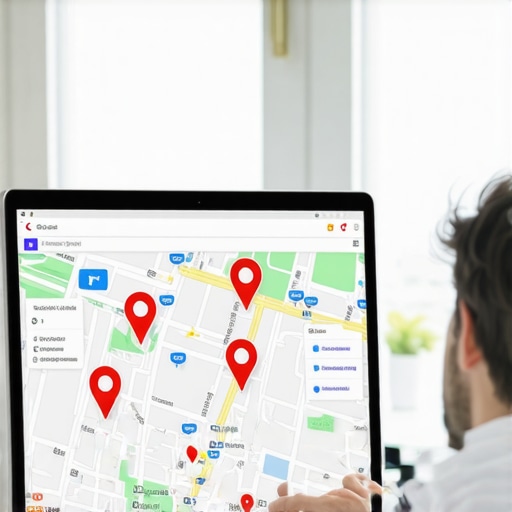
Why Expensive Local SEO Software Often Reports the Wrong Map Rankings
You’ve seen it before: the “Green Grid” of success. You log into your expensive local SEO dashboard, and there it is – a beautiful heat map showing your business sitting pretty at #1 across your entire city. You feel a sense of accomplishment. But then you look at your call logs. You check your lead forms. You look at your bank account. The “Green Grid” says you are winning, but the reality of your business says otherwise.
As a Google Business Profile Product Expert and consultant, I’ve spent years deconstructing why there is such a massive disconnect between what software reports and what customers actually see. If you want to truly master google business profile seo, you have to stop trusting the simulated data provided by “industry-standard” tools. The truth is, these trackers are often providing a sanitized, idealized version of the search landscape that doesn’t exist for a real human being walking down the street with a smartphone.
To rank google business profile listings effectively, you need to understand that local search is no longer a static leaderboard. It is a shifting, breathing ecosystem influenced by hundreds of real-time variables that most software simply cannot replicate. In this guide, we’re going to pull back the curtain on why your expensive rank tracker is lying to you and what you should be looking at instead.
Before we dive into the technical failures of these tools, it’s worth reading my previous breakdown on why your map rank tracker is lying about your actual neighborhood visibility to get a baseline understanding of the data discrepancies we deal with daily.
II. The “Pizza Expo” Reality Check: Why Rank #1 is a Myth
One of the most eye-opening moments in the history of local search occurred during a “Pizza Expo” experiment. A group of SEO researchers gathered 25 attendees in a single room. Every person was asked to take out their phone and search for the word “pizza.”
Logically, if they are all in the same room, using the same Wi-Fi or the same local cell towers, they should see the same results, right? Wrong. No two people in that room received the same search results.
This is the fundamental flaw in traditional google maps ranking service reporting. Most software uses “clean” browsers – virtual machines that have no search history, no cookies, and no logged-in Google account. Your customers, however, are not “clean.” They are messy. They have search histories. They have visited your competitors’ websites. They have “Location History” enabled on their iPhones and Androids that tells Google where they spend their time.
The Personalization Filter
Google’s algorithm is designed to provide the most relevant result for the individual, not the most relevant result for the keyword. If a user frequently visits a specific coffee shop, that shop will likely rank higher for them than a “better” optimized shop three blocks away. Expensive SEO software cannot simulate a user’s life. It can only simulate a coordinate. When you rely on a tool to tell you your rank, you are getting the “incognito” version of reality, which represents a tiny fraction of actual search behavior.
The Time-of-Day Variable
Rankings are not static throughout the day. Google understands “Open Now” intent better than ever. If your business closes at 5:00 PM and a user searches at 5:01 PM, you will likely drop out of the top three in favor of a competitor who is still open. Many rank trackers run their scans at 2:00 AM when server costs are lower. This results in a report that looks fantastic but is completely irrelevant to the peak hours when your customers are actually searching.
III. The Proximity Wall & The “At-Business” Glitch
Perhaps the most frustrating phenomenon in google business profile seo is what we call the “At-Business Glitch.” Have you ever stood inside your own office, searched for your primary service, and found that you aren’t even in the top 10? Then, you drive a mile down the road, search again, and you’re #1?
This isn’t a mistake; it’s a byproduct of how Google handles proximity and “Entity” verification. Standard local seo tools often fail to capture this because they simulate GPS coordinates using fixed API calls. They don’t account for the “Proximity Wall” – a radius where Google might actually suppress a result if it thinks the user is already at the location, assuming they are looking for a different destination.
I’ve written extensively about the proximity glitch that makes your rank tracker report fake map wins, but the core issue is that software uses a “point-in-time” simulation. Real users are moving. Google’s mobile algorithm factors in the speed of travel and the direction of movement. If a user is driving North at 45 MPH, Google is more likely to show them results that are North of their current position, rather than something they just passed. Your expensive software is sitting still; your customers are not.
The Failure of GPS Simulation
Most rank trackers use “IP-based” or “lat-long” spoofing. However, Google has become incredibly sophisticated at detecting simulated locations. When Google detects a search coming from a known data center IP (which most SEO tools use), it often serves a “default” or “cached” version of the Map Pack. This cached version doesn’t reflect the hyper-local nuances of a real mobile device using triangulated cell tower data and Wi-Fi SSID signals.
IV. Why Heat Maps are Often “Pretty Pictures” of Old Data
Heat maps (or Geo-grids) are the current “shiny object” in the local SEO world. They look impressive in client reports, showing a grid of 1s, 2s, and 3s across a map. However, these are often the most misleading tools in the shed. To effectively rank google business profile assets, you must realize that a heat map is a snapshot of the past, not a predictor of the future.
Data Lag and Data Centers
Google does not serve the same data from every data center simultaneously. There is a “propagation delay.” When you update your business description or add new photos, it might take minutes to show up in one data center and hours in another. Many expensive software platforms trigger searches through VPNs that bounce around different regions. This can lead to “false positives” where you appear to be ranking well because the tool hit a data center that hasn’t yet updated with a competitor’s new prominence or a recent algorithm tweak.
The Interpolation Trap
Heat maps don’t actually check every square inch of a city. They check specific nodes (e.g., every 500 meters) and then “guess” or interpolate the colors in between. This creates a smooth, beautiful gradient that suggests a consistent ranking. In reality, local SEO is “jagged.” You might rank #1 on one street corner and #15 on the next because of a high-authority competitor located on that specific block. The software “smooths” over the reality of your competition.
If you want to stop being fooled by these visuals, you should learn how to audit your business profile without using expensive tracking software and start looking at the raw data provided directly by Google.
V. The 2026 Shift: Entity Authority vs. Keyword Density
As we move toward 2026, the traditional way we track rankings is becoming obsolete. We are moving away from “Keyword Density” and toward “Entity Authority.” Traditional trackers are built to look for a specific string of text (e.g., “Plumber in Dallas”). But Google’s AI-driven search – including SGE (Search Generative Experience) and AI Overviews – doesn’t care about your keyword density as much as it cares about your “Entity” footprint.
What is Entity Authority?
Entity Authority is the cumulative trust Google has in your business as a real-world object. This is built through brand mentions, local news coverage, consistent NAP (Name, Address, Phone) data, and real user interactions. Most google business profile seo tools are still stuck in 2018, counting how many times “Plumber” appears in your reviews. They aren’t measuring your brand’s “clout” in the local ecosystem.
In the coming years, we will see “Zero-Click Map Snippets” dominate. This is where Google provides the answer (e.g., “Yes, they have emergency water heater repair available now”) directly in the map interface without the user ever clicking your profile. Traditional rank trackers can’t measure this. They only see if you are in the top 3; they don’t see if you actually solved the user’s problem at the search level.
For a deeper dive into this future, check out my article on Local SEO Trends 2026: Why Entity Authority Is Replacing Keyword Density.
VI. Better Metrics: What to Track Instead
If the “Green Grid” is a lie, what should you actually measure? To truly rank google business profile listings for profit, you must pivot from “Position” to “Interactions.” A #1 ranking that generates zero calls is a failure. A #4 ranking that generates 50 direction requests is a massive win.
You should prioritize the following metrics found in your Google Business Profile Insights:
- Direction Requests: This is the highest signal of “Intent to Buy.” No one asks for directions to a business they don’t plan on visiting.
- Direct Calls: Track the “Call” button clicks, but also use a dedicated tracking number to see the duration of those calls.
- Booking Hits: If you have an integrated “Book Now” button, this is your ultimate conversion metric.
- Search Queries (The Long Tail): Instead of tracking 5 “head” keywords, look at the 1,000+ unique queries Google shows in your dashboard. This tells you how people actually find you.
When you focus on google business profile optimization, you are optimizing for the human, not the bot. This leads to sustainable growth that doesn’t disappear the moment a software company changes its proxy provider.
VII. Conclusion & Action Plan
Expensive local SEO software serves a purpose – it’s great for high-level reporting and keeping clients happy with pretty pictures. But as a business owner or a serious marketer, you cannot let these tools dictate your strategy. The “Green Grid” delusion is a dangerous place to be. It leads to complacency while your actual market share might be eroding due to the proximity glitch, personalization, or the shift toward Entity Authority.
Stop obsessing over whether you are #1 or #2 on a simulated map. Instead, focus on the fundamentals:
- Perform manual, “dirty” searches from different devices and locations.
- Focus on building real-world “Entity Authority” through local engagement.
- Prioritize conversion metrics (Calls and Directions) over vanity rankings.
- Use a framework that accounts for the logical way Google actually ranks businesses.
If you’re ready to move past the software lies and implement a strategy that actually moves the needle, it’s time to look into the Mastering the Ranking Framework GBP: A Strategic Guide for 2025. We don’t chase ghosts; we build local dominance.
Don’t let a $200-a-month subscription tell you your business is healthy. Go out, stand on the sidewalk, and see for yourself. That is the only rank tracking that matters.