
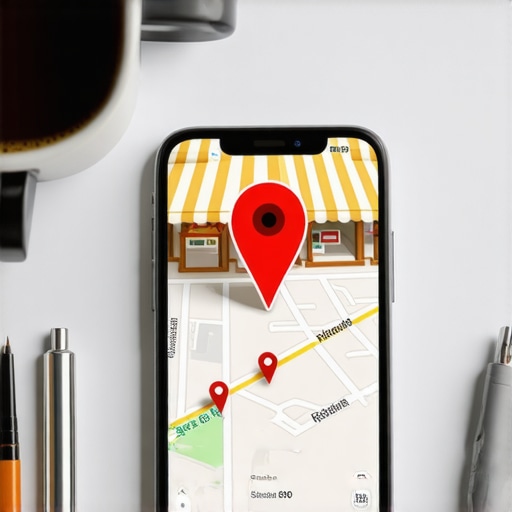
The office smells of peppermint tea and the dry, sweet scent of aging city records. I sit here with a stack of property tax files because Google often trusts a paper trail more than a digital one. My mission is simple. I protect local merchants from the algorithmic tide that favors nameless national chains. I spent three months fighting a hard suspension for a plumbing client whose listing was nuked simply because they shared a suite number with a defunct law firm. Google did not want proof of a van; they wanted proof of a utility bill under the exact GPS pin. That experience taught me that the Map Pack is not a marketing platform. It is a spatial database governed by unforgiving physics and microscopic math.
The ghost in the GPS coordinates
GPS coordinate salience and proximity signals determine your visibility in the Google Map Pack based on the latitude and longitude of the user. If your NAP data contains even a minor character mismatch, the algorithm loses confidence in your physical location, causing your ranking to drop. This is the proximity glitch at work. Most owners think they are invisible because of bad reviews. Usually, they are invisible because their digital pin is vibrating between two different data sets. If you want to understand the the proximity glitch that hides your business from customers standing a block away, you must look at how Google validates your door. One day your pin is on the curb. The next, it is in the middle of the street. This movement kills your trust score. You need to verify that your LocalBusiness schema matches your Google Business Profile dashboard down to the decimal point. I have seen businesses disappear because their how tiny n a p discrepancies ghost your business in local results investigation was ignored. We are talking about a distance-weighted signal. If the mobile device of the customer is three miles away, your relevance is secondary to your physical location. This is a mathematical reality. You cannot out-optimize a bad address. You have to fix the foundation first.
“Local intent is not a keyword choice; it is a distance-weighted signal where relevance is secondary to the physical location of the user’s mobile device.” – Map Search Fundamental
Why your physical address is a liability
Physical addresses acting as co-working spaces or virtual offices often trigger hard suspensions because they lack permanent signage and staffed hours. Google uses Street View data and third-party citations to verify that a legitimate local business exists at the verified coordinates provided. If you are sharing a suite, you are in danger. The algorithm sees two entities in one box and assumes one is a duplicate listing. I spent weeks fixing hard suspensions for service area businesses that tried to hide their home address behind a PO box. It never works. You must understand how to structure your gmb data for maximum local authority to avoid the automated filters. This is why unveiling the gbp structure keys to local search success is the first step for any serious local merchant. You should also check for internal link loops on your website. When your service area pages link back to the home page incorrectly, it creates a soft 404 error. You can find out how to fix internal link loops that cause soft 404 errors by auditing your site structure. Google needs a clear path from your map pin to your location-specific content. If that path is broken, your local authority vanishes. I see it every day. A business owner changes their suite number and their map position tanks. They think it is a penalty. It is just a data conflict. You have to be the primary source of truth for your own data.
Local Authority Reading List
- Mastering the Ranking Framework
- The NAP Discrepancy Guide
- Understanding Proximity Glitches
- How to Fix Hard Suspensions
- Structuring GMB Data
The three mile radius that determines your revenue
Centroid theory dictates that Google Maps prioritizes local businesses located closest to the geographic center of a search query. To expand your proximity radius, you must generate behavioral signals such as driving directions and click-to-call actions from users located outside your immediate zip code. This is about local search volume. If no one from the next town over is clicking your profile, Google assumes you are not relevant there. I often tell my clients that why your service area pages never turn into real map clicks is because they lack hyper-local entities. You need to mention the high school, the local park, and the regional intersection. This builds proximity authority. You can use gmb ranking tools for agencies to see where your ranking grid drops off. When you see that your business profile disappears when customers are only two blocks away, you know you have a signal strength problem. You might need to look at why niche citations move the needle more than a thousand generic directory links. A link from the local little league website is worth more than a hundred links from global directories. It places your business in a specific spatial context. Google uses triangulation. It looks at your site, your citations, and your user behavior. If all three points do not point to the same GPS coordinate, your visibility is capped at a three-mile radius. You stay small because your data is small.
How to survive the digital mob
Reputation management requires a forensic audit of user profiles to identify and report fake reviews that violate Google’s Terms of Service. Effective review repair services focus on flagging patterns like VPN usage and burst review activity to reestablish profile trust with the spam investigation team. I remember a cafe owner who was hit with twenty 1-star reviews in a single hour. It was a coordinated attack. We had to show the behavioral anomalies to Google. This is why a human-first approach to review repair and reputation management is better than any automated software. Software cannot see the spite. You need to know how to get reviews that mention specific services without being pushy because those keywords in reviews act as local justifications. When a customer says you are the best emergency plumber, Google highlights that text in the Map Pack. It is a massive conversion trigger. If you are struggling with a bad reputation, you should follow a step-by-step plan for rebuilding a tarnish local reputation. Do not just reply with canned responses. Stop using canned review responses if you want to dominate your local niche. It looks fake to the algorithm and the customer. You need real, contextual engagement. That is how you win the Map Pack. You treat every review like a conversation in the town square. People are watching. The algorithm is listening.
“Local search results are based primarily on relevance, distance, and prominence. These factors are combined to help find the best match for your search.” – Google Business Profile Guidelines
A surgical strike against competitor spam
Competitor spam fighting involves suggesting edits on keyword-stuffed business names and reporting lead-gen listings that use residential addresses to manipulate map rankings. By cleaning up the map, you remove unauthorized entities that push legitimate local merchants out of the top 3 results. It is a war out there. Some agencies use lead-gen tactics that eventually lead to permanent gmb suspensions. I have made a career out of seo services to detect and fight competitor gmb spam attacks. You have to be relentless. If a competitor is using a virtual office, you take a photo of the building directory and submit it. You show the map spam team that the entity does not exist. This is reclaiming your neighborhood territory after a competitor attack. You also need to audit your own backlink profile. Sometimes toxic local backlinks are tanking your map position without you knowing it. You can use a surgical approach to removing spammy backlinks in a local niche to clean your record. If you have been hit by an update, you need to know how to survive a local algorithm shake up without losing your rankings. It usually comes down to entity authority. Is your business a real thing in the real world? If the answer is yes, you can prove it. If the answer is no, no amount of gmb ranking tools will save you. You must be the authority in your niche. That means how local backlinks build real authority without triggering spam filters becomes your secret weapon. You build links from local sponsorships and neighborhood blogs. You become part of the local ecosystem.
The toolkit for long term map dominance
Google Business Profile tools should be used to audit NAP consistency and track map grid rankings across specific geographic coordinates. The best software to rank in google maps 3 pack provides unstructured citation cleanup and schema markup validation to ensure that search engines can parse business data without conflicting signals. I do not trust automated citation scans. They are lazy. Why relying on automated citation scans is keeping your profile out of the top 3 is a lesson many learn the hard way. You need to do the manual process for cleaning up fragmented business data. It is tedious. It is boring. But it works. You should also look at your photos. The specific photo update that doubled our profile interaction clicks was not a stock photo. It was a geo-tagged image of the storefront taken on a sunny day. It proved the location was real. If you are managing multiple locations, use the agency framework for managing multiple local profiles. Do not use the same service area descriptions for every city. Why duplicate content on city pages is killing your local reach is because Google sees it as a doorway page. You need unique local signals for every pin. This is how you force a google maps rank increase without buying another seo tool. You use the data you already have. You audit your business profile without using expensive tracking software by simply looking at your insights. Are people calling? Are they asking for directions? If not, your proximity signal is weak. You need to how to steal map leads from competitors who have more reviews than you by having better local justifications and photo metadata. The toolkit is not a piece of software. It is a strategic framework. It is a way of structuring your business so that the algorithm has no choice but to trust you. I keep my peppermint tea close and my NAP data closer. That is how we maintain map position when moving to a new office. That is how we recover map visibility after taking over a profile. We do the work that others are too lazy to do. We respect the physics of the map.