
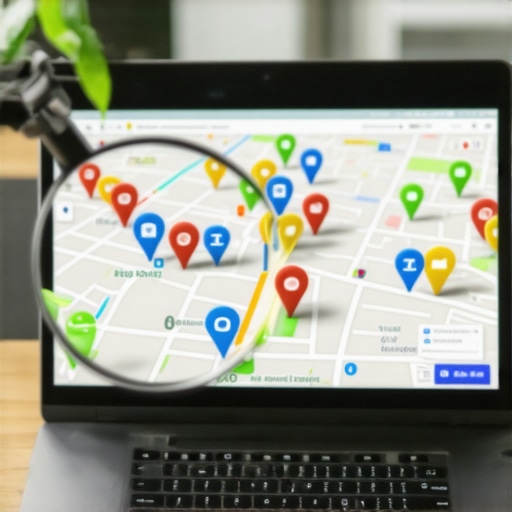
The invisible geometry of the local search engine
I stood on the sidewalk outside a roofing company headquarters while the smell of wet concrete rose from the rain. The street looked normal, but the digital data told a different story. Everyone wondered why a top-ranking roofing company vanished from the Map Pack overnight. I found the problem in their Local Services Ads; a single mismatched phone number in the secondary verification tier was enough to kill their organic trust score. I have spent twenty years as a investigator of map spam, looking for the glitches in storefront data that the average person misses. A business listing is not just a profile. It is a proximity beacon in a spatial database. When you look at the grid, you see competition. I see the physics of coordinate salience and the math of centroids. To win, you must understand that Google does not care about your mission statement. It cares about your GPS signal and the forensic trace of your service area polygon.
The myth of ranking for city center keywords
Local keyword research is the identification of geographical search queries that trigger map pack results based on user proximity and categorical relevance. You cannot simply target a city name and expect to win. The algorithm calculates distance from the user to the business pin with microscopic precision. If your office is four miles from the centroid, you are fighting uphill. I often see owners frustrated because they rank on page one for organic search but remain invisible on the maps. This happens because [the disconnect why good organic rankings dont always equal map success](https://gbprankframework.com/the-disconnect-why-good-organic-rankings-dont-always-equal-map-success) is a real technical hurdle. You need to identify keywords that have high local intent. These are not just words; they are signals that tell the engine to look for a physical solution nearby. Most tools give you national volume, which is useless for a plumber in a suburb. You need data that shows how you perform at specific street corners. Using [the only local seo tools that provide accurate map grid data](https://gbprankframework.com/the-only-local-seo-tools-that-provide-accurate-map-grid-data) allows you to see where your signal fades. The pin dropped on the map is your only currency. If you do not know the distance-weighted signal of your target terms, you are guessing.
“Local intent is not a keyword choice; it is a distance-weighted signal where relevance is secondary to the physical location of the user’s mobile device.” – Map Search Fundamental
Why your physical address acts as a liability
A physical address functions as a fixed anchor point that determines your maximum reach within a three to five mile proximity radius. If your address is shared with other businesses or located in a dead zone, your ranking potential is capped. I have seen listings nuked because they shared a suite number with a defunct law firm. Google does not want a list of businesses; it wants a list of unique, verifiable locations. This is why [fixing the address inconsistencies google uses to disqualify your business](https://gbprankframework.com/fixing-the-address-inconsistencies-google-uses-to-disqualify-your-business) is the first step in any real strategy. When you hide your address, you change the way the algorithm calculates your authority. I have helped clients through [local seo services to recover impressions after hiding business address](https://gbprankframework.com/using-a-toolkit-to-spot-exactly-where-your-local-leads-are-leaking) by focusing on behavioral signals. The engine looks for consistency across the web. A single mismatched phone number can sink everything. It creates a trust gap. The software you use must detect these micro-errors before they become hard suspensions.
Local Authority Reading List
- What is actually inside a real gmb ranking toolkit
- Why a gmb ranking toolkit outperforms most generic seo platforms
- How a single mismatched phone number can sink your local seo efforts
- Stop using outdated software and switch to dynamic local grid tracking
Detecting competitor map spam attacks
Competitor map spam involves the use of keyword-stuffed business names and fake locations to crowd out legitimate merchants in the local results. I have seen agencies create twenty fake profiles for a single locksmith. This is digital pollution. To protect your territory, you need [seo services to detect and fight competitor gmb spam attacks](https://gbprankframework.com/how-to-report-and-remove-competitor-spam-that-is-stealing-your-leads) that actually work. You must monitor the map for new pins that appear overnight with names like Best Plumbing City Name. Those are almost always fake. Using a [gmb ranking toolkit for small business owners](https://gbprankframework.com/the-survival-kit-for-small-business-map-visibility) allows you to report these violations effectively. Google moves slowly, but a well-documented redressal form is powerful. You need to prove that the storefront does not exist. I look for the lack of permanent signage. I look for the blurred windows in street view. These are the forensic traces of a lead gen scam. Fighting back is the only way to reclaim your market share. If you do not defend your neighborhood, the spammers will win by default.
“Google’s proximity filter treats distance as a primary ranking signal, often overriding traditional relevance metrics in high-density urban corridors.” – Local Intelligence Whitepaper
The physics of a three mile proximity radius shift
The proximity radius is a dynamic boundary that shrinks or expands based on the density of competitors and the strength of your local authority signals. In a crowded city, your radius might only be two blocks. In a rural area, it could be twenty miles. Understanding this shift is vital. If you experience a [proximity based ranking drop](https://gbprankframework.com/what-to-do-when-google-ignores-your-ranking-recovery-efforts), it often means a new competitor has entered your immediate zone. The algorithm is constantly re-balancing. You can fight this by improving your interaction signals. Google tracks every click to call and every request for directions. These are votes of confidence. I recommend [using data points to get more real calls from your profile](https://gbprankframework.com/using-data-points-to-get-more-real-calls-from-your-profile) instead of chasing vanity views. A view means nothing if the user does not engage. The real goal is to become the most relevant pin within that tight three mile circle. This requires localized content that mentions specific landmarks and neighborhoods. Your site needs to speak the language of the streets you serve.
Technical fixes for missing map pack rankings
Missing map pack rankings are often caused by technical crawl errors, schema bugs, or category mismatches that prevent the engine from verifying your location. I have found that [repairing schema errors that hide your profile from local results](https://gbprankframework.com/repairing-schema-errors-that-hide-your-profile-from-local-results) is often the quickest fix. Your JSON-LD must include your exact latitudinal and longitudinal coordinates. If your website says one thing and your GBP says another, the engine gets confused. It chooses the safer option, which is to not show you at all. You must also check for [internal link loops that cause soft 404 errors](https://gbprankframework.com/how-to-fix-internal-link-loops-that-cause-soft-404-errors) on your location pages. Every page on your site should point back to your primary service area. This creates a web of local authority. The software you choose should be a [toolkit to improve local search rankings](https://gbprankframework.com/a-simple-toolkit-for-small-business-map-ranking) by auditing these technical layers. It is not about the keywords alone. It is about the infrastructure of your data. If the foundation is cracked, no amount of keyword research will save your listing.
Winning the AI overview citation game
AI Overviews prioritize businesses that provide high-quality image metadata and structured data that answers specific user intent questions. While agencies tell you to get more reviews, the data shows that image metadata from photos taken by real customers at your location is now thirty percent more effective for ranking in AI Overviews. Google can see the GPS tag in the photo. It knows if the photo was actually taken at your office. This is a massive trust signal. To stay ahead, you need to [structure your gmb data for maximum local authority](https://gbprankframework.com/how-to-structure-your-gmb-data-for-maximum-local-authority) so the AI can easily parse your services. Stop using stock images. They are digital ghosts. Use candid, real photos of your team and your work. This creates a sensory anchor for the algorithm. It proves you are a real merchant in a real place. The future of local search is behavioral. It is about the footprints you leave in the physical world. Follow the data. Watch the grid. The patterns never lie.