
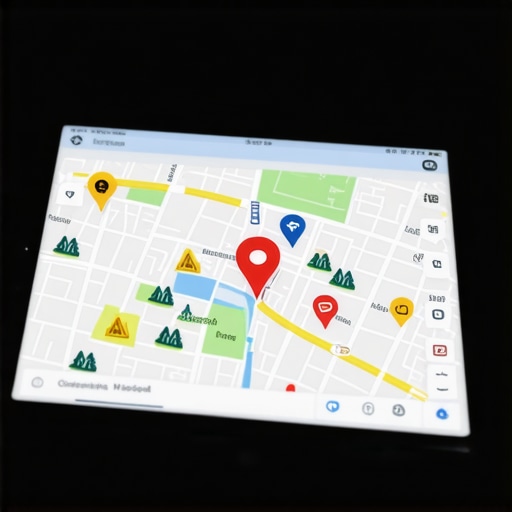
Why Your Map Rank Tracker is Lying About Your Neighborhood Visibility
Imagine this: You are a local plumber. You open your monthly SEO report, and the screen glows with a big, green “#1” next to your primary keyword, “plumber near me.” You feel a surge of pride. You’re winning. But then you look at your phone. It hasn’t rung in three hours. Your dispatch board is half-empty, and your lead-gen forms are gathering digital dust.
How is it possible to rank at the top of Google Maps and still be invisible to your actual customers? The answer is simple, yet devastating for your ROI: your google maps rank tracker is lying to you. Most of these tools are designed to give you a “vanity win” rather than a true reflection of your local market share. They report from a single, static point – usually your office or a generic zip code center – failing to account for the reality of how Google actually serves results to users on the move.
In the industry, we call this the “Proximity Glitch.” It is the phenomenon where a business dominates the map pack at its front door but falls off a cliff the moment a user walks two blocks south. If you are relying on a single-pin report, you are essentially looking at your business through a straw while your competitors are taking over the entire neighborhood. To truly understand your visibility, you must look at the proximity glitch that makes your rank tracker report fake map wins and understand why your current metrics are failing you.
The Myth of the Single Pin: Why Traditional Tracking Fails
Traditional SEO tools were built for the desktop era, where rankings were relatively stable across a city. But Google’s local algorithm has evolved into a hyper-localized, real-time auction. When a customer searches for a service, Google doesn’t just look for the “best” business; it looks for the best business right now for that specific coordinate.
Standard tracking software often checks rankings from a fixed IP address or a central node in a zip code. This creates a false sense of security. Customers are mobile; they are searching from their cars, their offices, and their homes. Because Google prioritizes the P-R-P Model – Proximity, Relevance, and Prominence – the “Distance” factor is incredibly volatile. If your google maps rank tracker isn’t simulating searches from multiple points across a grid, you aren’t seeing your ranking; you’re seeing a snapshot of a single, irrelevant point in space.
The P-R-P model dictates that:
- Proximity: How close is the business to the searcher?
- Relevance: How well does the profile match the search intent?
- Prominence: How well-known or authoritative is the business (reviews, backlinks, citations)?
The “Proximity” pillar is the strongest. Google will often prioritize a mediocre business that is 500 feet away over a world-class business that is 2 miles away. If your tracker isn’t testing that 2-mile radius point-by-point, you’re flying blind.
Why Your GMB Strategy is Failing the “Neighborhood Test”
I see it every day: a law firm or a dental practice with 500 five-star reviews wondering why they aren’t appearing in searches just three miles away. They have the “Prominence” (reviews) and the “Relevance” (optimized descriptions), but they are losing the “Neighborhood Test.”
Many owners believe that more reviews equal a larger ranking radius. This is a myth. While Google recently executed a massive Review Purge – blocking 292 million policy-violating reviews and removing 13 million fake profiles – having a mountain of reviews only helps if your google business profile optimization is tuned for hyperlocal signals. If your entity isn’t tied to specific neighborhood landmarks, sub-localities, and geo-coordinates, your “Prominence” stays tethered to your physical address.
You might be asking, Why Your GMB Strategy Is Failing Despite Having More Reviews Than Competitors? It’s because your competitors are likely doing a better job of establishing “Local Justifications” and “Service Area” signals that tell Google they are relevant to the user’s specific block, not just the general city. Without a localized strategy, your high review count is just a vanity metric that doesn’t translate into a wider reach.
The 2026 Reality: Ads, AI, and Zero-Click Searches
The landscape of google business profile seo has shifted dramatically. We are no longer just fighting other organic listings; we are fighting for space in a shrinking “Map Pack” window. Between November 2025 and January 2026, local pack ads surged by a staggering 733%. This means that even if you are the #1 organic result, you might actually be the 4th or 5th listing a user sees after the sponsored pins.
Furthermore, we have entered the era of the “Zero-Click Search.” Google’s AI-driven interface is designed to keep users on the search results page. They want the user to find your phone number, read your reviews, and see your photos without ever clicking through to your website. This is why you must Fix Ranking Framework GBP for 2026 Zero-Click Leads. Your profile must be a conversion machine in and of itself.
We are also seeing the rise of “Map Drift,” where AI-driven search results fluctuate based on real-time data like traffic patterns and business hours. If your google maps rank tracker doesn’t account for these shifts, you are making decisions based on outdated information. You need a tool that understands how AI interprets your business entity’s presence across the web.
From Vanity Metrics to “Entity Authority”
If you want to dominate your local market, you have to stop thinking about keywords and start thinking about Entities. Google doesn’t just see you as a “Plumber in Dallas.” It sees you as a unique entity within its Knowledge Graph, connected to specific services, locations, and consumer behaviors.
This is where “Entity Authority” comes in. It is the only metric that truly determines your ranking radius. I have argued previously why entity authority is the only local seo trend for 2026 that matters. To build this authority, you cannot rely on basic local seo software that only tracks keyword positions. You need geo-grid visualizations.
A geo-grid shows you a map of your city with a series of dots. Each dot represents a ranking from that specific coordinate. You might be #1 at your office (the center dot), but #8 just four blocks away. This visualization exposes the “holes” in your visibility. It allows you to see exactly where your “Entity Authority” ends and where you need to bolster your local signals – whether through localized content, geo-tagged images, or neighborhood-specific citations.
The Problem with “Average Rank”
Many agencies will tell you your “Average Rank” is 2.4. This is a useless number. If you are #1 in a 1-mile radius and #20 everywhere else, your average might look okay, but you are losing 90% of your potential market. You don’t want an average; you want a dominant radius.
How to Audit Your Neighborhood Visibility
If you suspect your reports are lying to you, it’s time for a reality check. You need to perform a comprehensive google business profile seo audit that focuses on the “Ranking Radius” rather than just the “Ranking Position.”
Follow this checklist to reclaim your territory:
- Audit Your “Service Areas”: Ensure your service areas in the GBP dashboard are not just broad counties, but specific neighborhoods where you actually want to rank.
- Analyze Competitor “Prominence”: Use a geo-grid tool to see who is outranking you in specific neighborhoods. Are they closer, or do they have better “Justifications” (the snippets of text Google pulls from reviews or your website)?
- Check NAP Consistency (The Entity Level): Ensure your Name, Address, and Phone number are identical across the web, but more importantly, ensure they are linked to your “Entity ID” in Google’s Knowledge Graph.
- Review Your Local Content: Does your website have pages dedicated to the specific neighborhoods where you are failing the “Neighborhood Test”?
For a deeper dive into this process, I recommend utilizing A Ranking Framework GBP Audit to Reclaim Your Neighborhood Territory. This isn’t just about fixing typos; it’s about realigning your digital presence with Google’s proximity requirements.
Conclusion: Dominating the Ranking Radius
The days of trusting a single-point ranking report are over. If you want your phone to ring, you have to stop chasing vanity metrics and start dominating your ranking radius. Google’s algorithm is smarter than ever, and with the 733% surge in map ads and the rise of AI, there is no room for “good enough” SEO.
Your goal shouldn’t be to rank #1 at your office; it should be to rank #1 in the homes and offices of your customers, regardless of where they are in your city. Stop wasting your marketing budget on blind strategies that don’t account for the proximity glitch. It’s time to improve google maps rankings by focusing on what actually moves the needle: Entity Authority and Hyperlocal Relevance.
Ready to see the truth about your visibility? Explore the Map Profile Framework and start recovering your lost neighborhood territory today. Your competitors are already moving in – don’t let them take your backyard.