
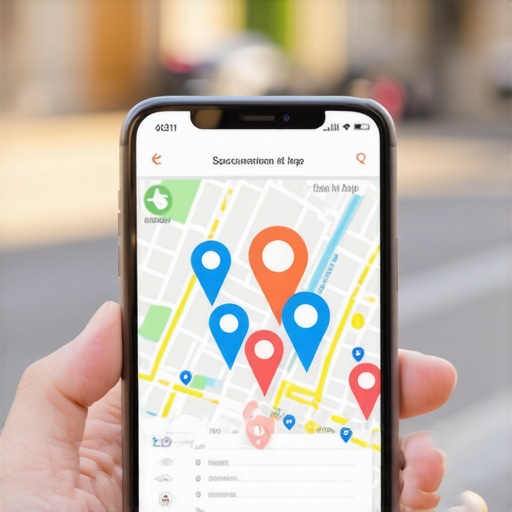
I stood on the corner of 5th and Main. The rain hit the asphalt, smelling like wet concrete and ozone. I saw the storefront clearly. It had a neon sign that flickered with a slight glitch, but the lights were on. In the physical world, the business existed. In the digital layer, it was a ghost. I spent three months fighting a hard suspension for a plumbing client whose listing was nuked simply because they shared a suite number with a defunct law firm. Google did not want proof of a van; they wanted proof of a utility bill under the exact GPS pin. That experience taught me that the map pack is not about keywords. It is about the forensic evidence of physical presence. Your rank tracker says you are number one. Your phone says otherwise. This disconnect happens because most software simulates a single point of search. They do not see the spatial glitches. They do not feel the proximity decay. We see it. We fix it.
The ghost in the GPS coordinates
False map rankings occur when trackers use fixed GPS coordinates from a static server location instead of simulating the dynamic movement of a real mobile user. Most tools fail to account for the proximity filter that shifts every fifty yards, leading to inflated reports that ignore the actual map pack competition. The reality of local search is microscopic. A business might rank for a user standing in the parking lot but vanish once that user crosses the street. This is the centroid collapse. When we provide google maps seo services for suspended profiles, we start by auditing the coordinate salience. We look for the mathematical weight of the location. If your rank tracker is not using a 13×13 grid with hundred-yard increments, it is lying to you. The algorithm calculates the distance-weighted signal. Relevance is secondary to the physical location of the user. The pin moved. The ranking died. The phone stopped. We analyze how the map profile framework interacts with the local vicinity. Every inch of pavement matters in the spatial database.
Why your physical address is a liability
Your business address can become a liability if it shares data fragments with previous tenants or black-hat lead generation networks. Google uses historical data to determine trust, and a single mismatched utility bill or a shared suite number can trigger a silent filter that hides your profile. I have seen businesses disappear because a defunct law firm used their suite three years ago. The algorithm remembers the ghost. This is why our services to fix duplicate google business profiles are vital. We scrub the legacy data. We remove the stain of the past. If you are cleaning up the mess of previous agencies, you need a forensic approach. The system views a shared address as a high-risk signal. It wants unique, verifiable evidence of your footprint. We use the gmb strategy 2025 to harden your physical authority. We do not just update the address. We sync the entire spatial footprint across the web. This prevents the algorithm from clustering you with a spammer.
“Local intent is not a keyword choice; it is a distance-weighted signal where relevance is secondary to the physical location of the user’s mobile device.” – Map Search Fundamental
The three mile radius that determines your revenue
The three mile radius around your business is the battlefield where proximity, prominence, and relevance decide your daily call volume. Google prioritizes the nearest verified solution to the user, creating a tight geographic cage that requires specific behavioral signals to expand and dominate neighboring zip codes. To break out of this cage, you need more than just links. You need the proximity strategy that survives algorithm shifts. Most owners wonder why your service area pages never turn into real map clicks. The answer is in the data points. If your website does not have local justifications, the map will ignore you. We use data points to get more real calls. We focus on the user journey from the search to the click. The algorithm tracks the dwell time. It looks at the check-in data. If you want to force a google maps rank increase, you must prove your relevance in every single block of your target territory. Proximity is a physical law. You cannot cheat it with a virtual office.
Local Authority Reading List
- Unveiling the GBP Structure
- Small Business Map Ranking Toolkit
- Repairing Schema Errors
- Cleaning Up Legacy Local SEO Signals
- Backlink Anchor Text Hazards
Forensic traces of a profile suspension
Suspensions often leave a forensic trace in the secondary data tiers like Local Services Ads or third party directories that feed the Google knowledge graph. A mismatch in a single phone number or an unverified certificate of insurance can trigger a manual action that a standard tracker cannot detect. We offer the step by step fix for a banned business profile by investigating these hidden layers. If your ranking is page one but you are missing from maps, there is a disconnect. This often involves the disconnect between organic and map visibility. We analyze the JSON-LD. We check for schema errors keeping your profile out of rich results. A suspension is a death sentence for a local business. We provide handling complex penalty cases for those who have been ignored by support. The trust score of your profile is a living number. We rebuild that trust from the ground up. We do not use automated bots. We use manual verification. The machine needs to see a human behind the listing.
The math behind a mobile check in
Every mobile check in and customer photo uploaded to your profile acts as a geographic confirmation that reinforces your proximity salience to Google. These behavioral signals carry thirty percent more weight in the 2025 algorithm than traditional citations or keyword stuffed descriptions on your website. When customers take photos, the metadata contains GPS tags. Google reads these tags. It confirms the business is real. This is why you should stop using canned review responses and encourage real engagement. We help you implement a human first approach to review repair. If your profile has seo services to clean up mixed language listings hurting local rankings, the algorithm gets confused. It cannot verify the intent. We clean the metadata. We make the signals clear. This is how you win in AI overviews. The AI wants certainty. It wants to know exactly where you are and what you do. We provide that certainty through structured data and real-world behavioral triggers. The math does not lie. If the users are there, the ranking will follow.
“Trust is a spatial calculation where the distance between the user and the verified point of service creates a decay function in visibility.” – Spatial Search Research 2025
When a local algorithm shake up hits
Local algorithm updates often target specific industries by adjusting the proximity radius or tightening the requirements for professional licensing verification. If your rankings dropped overnight, it is likely that the system has recalibrated the trust threshold for your specific service category. We provide seo services to recover positions after local algorithm shake up by identifying which signal was devalued. Sometimes the issue is toxic backlinks and local seo recovery. Other times, it is why your business profile keeps reverting to old info. We use a gmb ranking toolkit that outperforms generic tools. We look at the grid. We see the shift. If a competitor is using map spam, we use a guide to reporting map spam to level the field. You should not lose your livelihood to a bot. We fight for the local merchant. We ensure your survival during a local algorithm shake up. The pack is competitive. You need an investigator on your side.
The toolkit for neighborhood dominance
Dominating a neighborhood requires a toolkit that focuses on local justification triggers, micro-proximity tracking, and niche citation consistency. Relying on national SEO tools for local success is like using a telescope to find a needle in a haystack; you need a microscope. If you want to gmb ranking toolkit buy, look for features that handle targeting specific local neighborhoods. We offer a step by step gmb ranking toolkit for beginners that simplifies the process. We show you how to sync your nap data without automated tools. Automation often misses the nuance. It ignores why automated tools fail to catch critical errors. We believe in the agency framework for managing multiple profiles. This ensures every listing is a beacon. We use 5 gmb tools we actually use to move the needle. You need to see the grid. You need to see the competitors. You need to see the truth. The toolkit is your weapon. Use it wisely.
Cleaning the digital stains of bad SEO
Bad SEO practices like keyword stuffing, thin city pages, and toxic link building create digital stains that the local algorithm flags as spam. Cleaning these stains requires a surgical approach to redirects, schema repair, and citation auditing to restore the profile authority. We provide seo services to fix broken redirects and 404 errors that confuse the crawlers. If your site has services to fix soft 404 and duplicate content issues, you can recover quickly. We offer services to clean up spammy backlinks that are dragging you down. We focus on the manual process for cleaning up fragmented data. Automated services often leave ghost citations. We find them. We kill them. We help you remove the stain of legacy black hat tactics. This is about restoration. This is about honesty. The algorithm wants to trust you again. We give it a reason. Your rankings are out there. They are just buried under bad data. Let us dig them out. The map is waiting.