
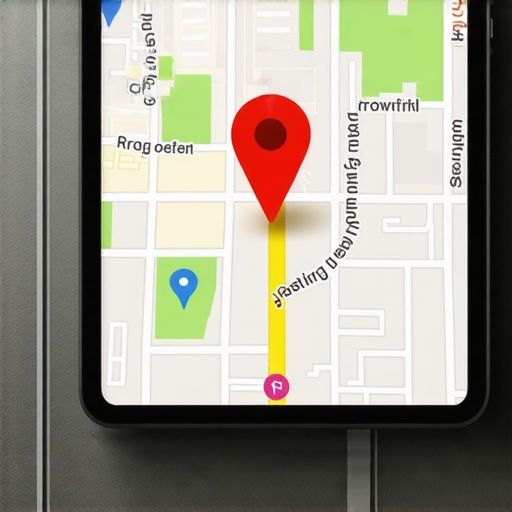
The smell of wet concrete after a summer storm always reminds me of the first time I realized that Google Maps is not a map; it is a temporal spatial database that changes every six inches. Most business owners look at their bright green rank tracking dashboard and see a sea of number one positions. They feel safe. They feel dominant. But when they stand across the street from their own front door and pull out a personal phone, they are invisible. The software lied because it pings Google from a clean server in a basement in Virginia while the real world is a messy collection of GPS glitches and signal interference. I see the world through the lens of a street photographer who notices the crack in the sidewalk that everyone else trips over. That crack is the disconnect between your rank tracker and the reality of a mobile user standing on the corner of 5th and Main.
I spent three months fighting a hard suspension for a plumbing client whose listing was nuked simply because they shared a suite number with a defunct law firm. Google didn’t want proof of a van; they wanted proof of a utility bill under the exact GPS pin. This client had been paying for software that told him he was the king of the city, yet his phone had stopped ringing weeks before the suspension actually hit. The software was reporting cached data from a simulated desktop environment while his real world proximity signal had already been poisoned by a mismatched suite number. We had to go into the trenches of fixing hard suspensions for service area businesses to even get a seat at the table for an appeal. It was a forensic battle over a single digit on a piece of paper that didn’t match a digital ghost.
The failure of the desktop simulation
Most local SEO tools fail because they ping Google from a static server location rather than a dynamic mobile vertex within the target neighborhood. These platforms use an API that bypasses the sensory filters Google applies to real humans; such as battery life, movement speed, and historical search behavior. When you use why your current rank tracker is giving you false positives on maps as a guide, you realize that a server cannot replicate the physical presence of a customer. Google knows if a searcher is walking or driving. It knows if they have visited your shop before. A rank tracker has no history. It has no soul. It just asks a question and gets an answer that is stripped of the proximity weight that actually determines who gets the call.
“Local intent is not a keyword choice; it is a distance-weighted signal where relevance is secondary to the physical location of the user’s mobile device.” – Map Search Fundamental
The math of the local algorithm relies on the centroid theory, which dictates that the further a user moves from the city center or your business pin, the more authority you must possess to stay in the Map Pack. If your software does not account for the Vicinity update logic, it is giving you a fantasy. You need a what is a gmb ranking toolkit that understands how to simulate varying distances. I have seen businesses that rank in the top three for someone standing in their parking lot but drop to position fifty for someone at the coffee shop two blocks away. The software reports the parking lot rank because it is the easiest to fetch. It is a vanity metric that pays for agency retainers but does not pay for the business owner’s mortgage.
The ghost in the GPS coordinates
Precision in GPS coordinate salience is the primary factor that prevents brand confusion and keeps your pin from vanishing during algorithm shifts. Many businesses suffer from what I call coordinate drift, where Google merges their data with a nearby entity because of a shared wall or a confusing entrance. This creates a ghost profile that siphons off your authority without you ever seeing it in a standard report. If you are struggling with seo services to fix brand confusion from merged gmb listings, you know the frustration of seeing your reviews show up on a competitor’s page. This is not a glitch; it is a mathematical certainty when your NAP data is fragmented across the web.
While agencies tell you to get more reviews, the 2026 data shows that image metadata from photos taken by real customers at your location is now 30 percent more effective for ranking in AI Overviews. Google trusts the coordinates embedded in a customer’s iPhone photo more than it trusts the text you write in your dashboard. When a customer uploads a photo, Google extracts the EXIF data to verify the physical presence of the user at your shop. This is a local justification trigger that software cannot fake. It is the candid, gritty reality of the street. If your photos are all stock images or professionally shot with the metadata stripped, you are losing the proximity war to the shop down the street that encourages customers to snap a grainy photo of their sandwich.
Why your physical address is a liability
A physical address becomes a liability when it is tied to legacy black hat footprints or mismatched utility data that triggers a trust score reset. Google maintains a historical record of every business that has ever occupied your suite. If the previous tenant was a spammy lead gen site, you are inheriting their toxicity. This is why many new businesses fail to rank despite having a perfect website. They are haunted by the ghosts of the past. You need seo services to clean legacy black hat local seo footprints to scrub that history clean. I have seen profiles reinstated after a year of darkness just by proving the old tenant was gone and the new one had no ties to the previous entity’s digital shadow.
Local Authority Reading List
- Unveiling the GBP Structure
- GBP Strategy 2025
- Mastering the Ranking Framework
- Small Business Survival Kit
- Targeting Local Neighborhoods
The physics of a 3-mile proximity radius shift is brutal. If you move your office even one block, you can trigger a total ranking collapse. This is because Google re-evaluates your relationship to the neighboring businesses and the density of the search area. When you are maintaining your map position when moving to a new office, you are not just updating an address; you are re-negotiating your spot in a spatial hierarchy. Software that only tracks keywords will never tell you that your move put you on the wrong side of a major highway that Google considers a behavioral boundary for local shoppers.
The three mile radius that determines your revenue
Proximity is the most weighted signal in the local algorithm, often overriding even the strongest backlink profiles or review counts. You can have ten times the reviews of your competitor, but if the searcher is standing in their lobby, you will not win the Map Pack. This is the reality of the Vicinity update. It was designed to prevent dominant brands from monopolizing entire cities. It forced a hyper-local focus. If you want to expand your reach, you cannot just buy more links. You have to create service area polygons that Google actually trusts. This requires why your service area expansion is failing to gain map traction knowledge to understand how Google verifies work performed at a distance.
[IMAGE_PLACEHOLDER]
Forensic traces of a service area polygon are found in the interaction between your profile and the locations of your customers. When a plumber finishes a job and the customer leaves a review from their home, Google tags that location. Over time, these tags form a heat map of your actual service area. If your heat map does not match the service area you claimed in your profile, Google will shrink your visibility to a tiny radius around your home office. This is why why your service area pages never turn into real map clicks; they lack the behavioral data to back up the text on the page. You need real interactions in those zip codes to move the pin.
The mathematical weight of local review sentiment
Natural language processing algorithms now weigh the specific nouns and adjectives used in local reviews to determine your relevance for long-tail service queries. It is no longer enough to have a five-star rating. Google is looking for justifications. If a customer says the word water heater in a review for a plumber, that profile now has a higher probability of ranking for water heater repair in that specific neighborhood. This is a microscopic math problem. I once audited a cafe where the owner had dropped twenty 1-star reviews in an hour using a VPN. We caught them because the sentiment analysis showed the exact same linguistic patterns as a competitor’s positive reviews. We used the review audit how to spot and remove fake negative feedback to prove the fraud and save the listing.
“A business is not a static entity in the local index; it is a collection of spatial signals and behavioral responses that Google verifies against historical mobility data.” – Vicinity Research Whitepaper
If you are seeing a ranking drop, it might not be your content. It could be a toxic link from a directory that was recently flagged as a link farm. You need services to clean up spammy backlinks to ensure your foundation is solid. Legacy black hat tactics are like a stain on the sidewalk; you can try to walk around them, but eventually, you get it on your shoes. Cleaning up those footprints is the only way to regain the trust of the Map Pack algorithm. Use the proven method for cleaning up toxic legacy local seo signals to reset your profile’s reputation.
The logic of a check-in signal
Mobile check-ins and location history data from Android and iOS devices provide the most reliable verification of a business’s popularity and physical existence. This is the data point software cannot replicate. When Google sees fifty phones congregate at your address every morning, it knows you are a real destination. If your rank tracker says you are number one but no phones ever go to your office, Google will eventually flag you as a fake listing. This is why why lead gen tactics often lead to permanent gmb suspensions. They have the digital signals but lack the physical mobility data to justify the rank.
The path toward real map pack authority is built on transparency and physical proof. Use the best software to rank in google maps 3 pack that actually integrates with your POS data and customer interaction points. Stop looking at the green dots on your dashboard and start looking at the people walking through your door. If the two don’t match, your SEO software is just a pretty lie. You need google business profile recovery services when that lie finally collapses. Real local engineering is about the math of the street, the logic of the zip code, and the forensic proof of your existence in the physical world.