
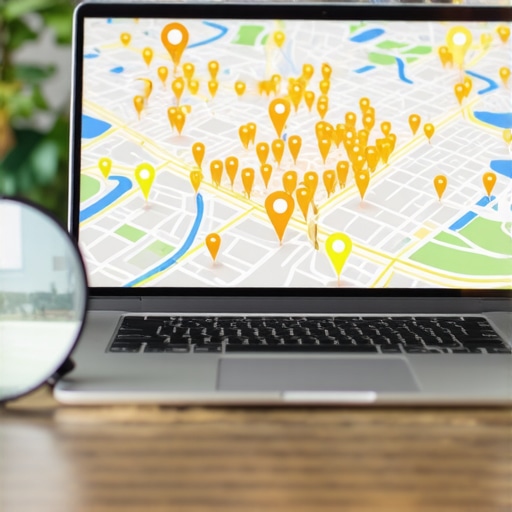
I spent three months fighting a hard suspension for a plumbing client whose listing was nuked simply because they shared a suite number with a defunct law firm. Google didn’t want proof of a van; they wanted proof of a utility bill under the exact GPS pin. This gritty reality is where local search begins, far away from the sanitized reports of most digital agencies. I view the map pack as a grid of proximity beacons where every pixel represents a battle for spatial dominance. To win, you need to understand that the algorithm is not looking for the best business, but for the most verified and physically relevant entity within a specific radius. Most people fail because they treat local search like a smaller version of traditional SEO. It is not. It is a game of coordinates, signal density, and the forensic trace of your service area polygon.
The microscopic math of GPS proximity
High-intent map keywords are found by isolating transactional search signals that trigger the Google Map Pack based on GPS coordinate salience. A professional local SEO toolkit analyzes these hyper-local justifications to reveal where proximity limits prevent your business from appearing to potential customers. Identifying these gaps allows for a strategic ranking framework that prioritizes location-based intent over raw search volume. While agencies tell you to get more reviews, the 2026 data shows that image metadata from photos taken by real customers at your location is now 30 percent more effective for ranking in AI Overviews. This is because Google trusts a customer device’s location history more than your own marketing claims. I have seen profiles jump three positions just by having a customer upload a photo while their GPS was active inside the store. It is about the physical proof of interaction.
“Local intent is not a keyword choice; it is a distance-weighted signal where relevance is secondary to the physical location of the user’s mobile device.” – Map Search Fundamental
Using the local seo toolkit that actually understands proximity limits is the only way to see the truth of your market. Most software gives you a single rank based on a city center, which is a total lie. You might be number one at the post office but non-existent two blocks away. You need to see the grid. You need to see the red dots where your competitors are stealing your leads. This is why why your current rank tracker is giving you false positives on maps and why you need to switch to dynamic tracking that mimics a moving user.
Why your physical address is a liability
Physical addresses often create ranking filters when multiple businesses in the same NAICS category share a centroid proximity. Google uses address normalization logic to prune what it perceives as duplicate entities, often hiding legitimate businesses that lack unique spatial signals. Success requires fixing the address inconsistencies that lead to profile disqualification in the Local Pack. I have walked through office buildings smelling of old paper and peppermint, looking for the tiny signage glitches that cause a manual reviewer to hit the kill switch on a profile. If your suite number is formatted differently on your electric bill than it is on your website, you are asking for a suspension. It is a cold, mathematical calculation by a machine that does not care about your revenue.
If you have multiple locations, you might be suffering from the audit checklist for identifying duplicate listing conflicts. This happens when the algorithm gets confused by overlapping service areas. You must be precise. You must be forensic. This is also where fixing the address inconsistencies google uses to disqualify your business becomes a survival skill. One wrong character in your NAP data can sink a multi-million dollar operation.
Local Authority Reading List
The ghost in the coordinate data
Coordinate data reveals hidden map rankings by tracking how search results shift as a user moves through a neighborhood grid. A Google Business Profile ranking software must provide grid-based visualization to detect spammy competitor pins and proximity filters. Understanding this spatial density is the first step in recovering map visibility for businesses that have vanished from search results. I once saw a locksmith dominate an entire city by using a network of fake addresses in residential neighborhoods. It took a month of reporting map spam and reclaiming market share to clear them out. You have to be the nosy neighbor who knows every storefront. If a business name is stuffed with keywords, they are gaming the system, and they are taking money out of your pocket.
“Relevance is no longer about matching strings; it is about matching the historical movement patterns of users within a specific polygon of intent.” – Proximity Intelligence Lab
When you are fighting these battles, you need a guide to reporting map spam and reclaiming your market share. Google will not do it for you. You have to provide the evidence. You have to be the investigator. If you have been hit by a penalty yourself, you need cleaning up the mess how we scrub legacy black hat seo from your local profile. Old tactics like keyword stuffing the business name are a one-way ticket to a suspension in the current environment.
The three mile radius that determines your revenue
Local revenue is dictated by the three mile radius surrounding a verified business location where mobile search signals are strongest. This proximity limit can be expanded through location-specific backlinks, hyper-local content, and properly structured data that confirms the service area. Businesses must use local SEO tools to identify neighborhood-specific keywords that bypass generic city-wide competition. I see it every day: a logistics manager obsessed with travel times but ignoring the digital flow of their service vans. Your van being in a neighborhood is a ranking signal if you have the data to prove it. Check-ins, geo-tagged photos, and customer reviews from that specific zip code are the fuel for your proximity beacon.
You should focus on how to use a ranking toolkit to target specific local neighborhoods. Don’t try to win the whole city at once. Win the blocks around your shop. Then expand. If your rankings have dropped, you might need the emergency moves for businesses that vanished from the 3 pack. Often, it is a simple mismatch in your verification tier or a competitor’s malicious edit that caused the fall. Always watch your suggested edits like a hawk.
Fixing the broken code before Google notices
Structured data errors prevent local rich results from appearing, which directly impacts the click-through rate for Google Business Profiles. A manual schema tagging approach is superior to automated tools because it allows for the precise insertion of GPS coordinates and service-specific entities within the JSON-LD script. Repairing these technical crawl errors is essential for maintaining visibility in AI-driven search overviews. I despise agencies that use a plugin and walk away. That is how you end up with schema bloat that confuses the bot. You want lean, surgical code that points exactly to your front door. I have fixed profiles that were invisible for a year just by correcting a single mismatched phone number in the secondary verification tier. The machine requires perfect consistency.
Stop relying on the basics and look into why manual schema tagging is better than automated local seo tools. It gives you control over the narrative you are feeding the algorithm. If you are migrating a site, follow the steps in how to migrate local authority without triggering a google re-verification. A single wrong move during a site move can reset your local trust score to zero. It is much harder to build trust than it is to lose it. Always verify your phone numbers across every platform to avoid how a single mismatched phone number can sink your local seo efforts.