
Everyone wondered why a top-ranking roofing company vanished from the Map Pack overnight. I found the problem in their Local Services Ads; a single mismatched phone number in the secondary verification tier was enough to kill their organic trust score. As a logistics manager, I see the Map Pack as a dispatch system. When the dispatch data is corrupted, the trucks stop moving. I have spent years staring at routing tables and GPS coordinates, and I can tell you that Google is no longer looking for a general city center. It is looking for hyper-local relevance that changes every six hundred feet. If your data is not surgical, your business is invisible. I smell diesel and stale coffee from late nights spent auditing these failures. The local algorithm is a cold, mathematical beast that calculates the physics of a three-mile proximity radius shift with terrifying precision.
The neighborhood grid is the only map that matters
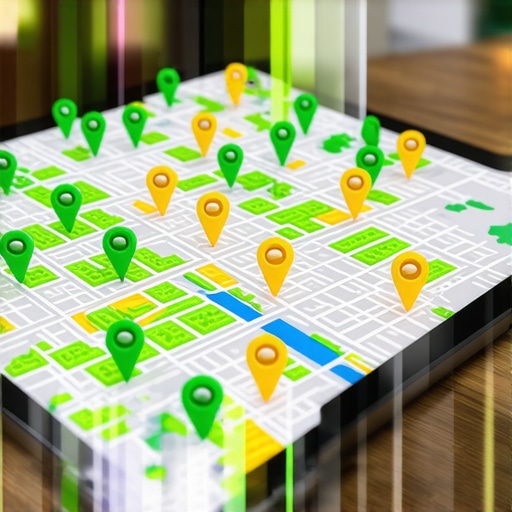
Hyper-local tracking software enables businesses to visualize their Google Business Profile visibility through a coordinate-based grid. This technology bypasses the inaccuracy of city-center reporting by simulating user searches at specific GPS points. It identifies exactly where your map pin loses authority to competitors in real-time. Many owners rely on tools that tell them they are number one in their city, but that is a lie. You might be number one at the post office and number ten at the coffee shop three blocks away. This is why you need tools that actually track local grid movements instead of just city centers to see the real picture. If you are not looking at the neighborhood level, you are essentially driving a semi-truck with a broken compass. You think you are on the right path while you are actually leaking fuel in a dead zone.
“Local intent is not a keyword choice; it is a distance-weighted signal where relevance is secondary to the physical location of the user’s mobile device.” – Map Search Fundamental
The ghost in the GPS coordinates
Coordinate salience refers to the strength of a business entity’s physical location data within the Google Maps database. When multiple listings share fragmented data or addresses, the algorithm triggers a proximity filter that hides overlapping businesses. This forensic trace determines whether your pin appears for nearby users. I have seen listings destroyed because they shared a suite number with a defunct law firm. Google did not care about the sign on the door. They cared about the digital ghost left behind by the previous tenant. To fix this, you often need seo services to fix gmb issues caused by virtual office or coworking space environments. These spaces are notorious for data pollution. The algorithm sees five hundred businesses at one pin and decides to show none of them. It is a logistics nightmare that requires manual intervention to prove your physical presence is legitimate.
Local Authority Reading List
- Streamline your local listing framework
- GMB Strategy 2025 Guide
- Multi-location reporting software analysis
- Spotting local lead leaks
- Profile fixes for service businesses
Why your physical address is a liability
Physical addresses become liabilities when they are associated with historic spam, poor citation consistency, or outdated brand entities. Google assigns a trust score to every set of latitude and longitude coordinates. If your address is flagged for suspicious activity, all listings at that location suffer. While most agencies focus on getting you more reviews, the recent data shows that customer-taken photos are thirty percent more effective for ranking in AI Overviews. This is because raw metadata from a customer’s phone confirms they were actually at your site. If your address has a bad history, you might need local seo services for cleaning historic citation spam campaigns to scrub the record clean. It is like trying to deliver a package to a house that is listed as a vacant lot in the master database. You have to update the registry before the driver can find the porch.
The forensic audit of category choices
Strategic category selection involves identifying the primary and secondary classifications that align with Google’s local justification triggers. Choosing the wrong category can suppress your listing even if your location and reviews are superior to competitors. This requires a deep dive into entity-level mapping data. I once watched a plumber lose half his leads because he chose ‘HVAC Contractor’ as his primary category instead of ‘Plumber’ during a seasonal shift. He thought he was being clever by targeting a high-ticket service, but the algorithm saw it as a mismatch for his core business name. You need a gmb keyword and category research toolkit to ensure you are not making these fatal errors. The local algorithm operates on a strict hierarchy. If you are not in the right box, you do not exist in the neighborhood search results. It is about efficiency and dispatch logic. Google wants to provide the most logical answer to the user’s immediate problem.
“Relevance is measured through the lens of user behavioral signals and the consistency of the NAP data across the structured web.” – Local Search Intelligence Report
The three mile radius that determines your revenue
Proximity limits represent the maximum distance from a business location where its profile remains competitive in the Map Pack. This radius is influenced by the density of competitors and the strength of your local authority signals. Most businesses see a sharp drop in visibility beyond three miles. If you are struggling to break out of a small area, you should look into the software fixes that actually pull your map pin into the top 3 results. The pin moved. The market changed. Your visibility is a dynamic thing that shifts every time a new competitor verifies a listing. I treat these perimeters like delivery zones. If my truck cannot reach the customer in ten minutes, the dispatch system finds another driver. Google does the same thing with its search results. It optimizes for the shortest path to a satisfied user. If you want to expand that zone, you have to prove that your entity is so authoritative that the algorithm should ignore the extra mile of travel.
The hidden cost of citation inconsistency
NAP inconsistencies occur when a business’s name, address, or phone number varies across the web. These discrepancies fragment your local authority and prevent the algorithm from confidently associating your website with your physical pin. Correcting these errors is essential for recovering lost map rankings. I have found that a single comma or a misspelled street name in a directory from 2012 can still haunt a modern listing. You should hire local seo services to fix nap inconsistencies if you want to clear the path for your trucks. It is the digital equivalent of a bridge being closed on a route. Your data is trying to get to the destination, but the path is blocked by a technicality. The logistics of the web require total uniformity. Any deviation is seen as a signal of unreliability. Google hates unreliability because it reflects poorly on their map accuracy.
The neighborhood survival guide for local agencies
Agency-level local SEO requires tools that can manage high-volume profile data while maintaining granular control over neighborhood-specific rankings. Success is measured by the ability to respond to algorithm shifts and competitor spam before they impact client revenue. You need a robust how to improve google business profile ranking toolkit to stay ahead of the curve. Most tools only give you a surface-level view. They do not tell you about the ghost listings or the suggested edits that are slowly poisoning your client’s data. I have watched competitors suggest edits to business hours just to make a listing show as ‘Closed’ during peak search times. This is war. It is not just about rankings; it is about defending your territory from aggressive actors. If you are not monitoring your profile daily, you are leaving your gates unlocked.
Forensic tools to fix the GMB category error
Category research tools analyze the top-ranking profiles in specific niches to identify the exact classification strings that trigger Map Pack appearances. Using these tools allows businesses to find untapped service categories that competitors have overlooked. This is the secret to finding the gold in the data. You can use the hidden data in gmb categories your competitors dont see to gain a massive advantage. While everyone else is fighting over the main category, you can dominate the sub-categories and capture the long-tail traffic. It is like knowing the side streets that bypass the highway traffic. You get to the customer faster because you are not sitting in the same queue as everyone else. Efficiency wins in the Map Pack. The logistics manager knows that the shortest route is often the one that nobody else is looking at. Stop following the crowd and start looking at the grid data. That is where the money is hidden.